
What Your Builder's Credit History Can Tell You
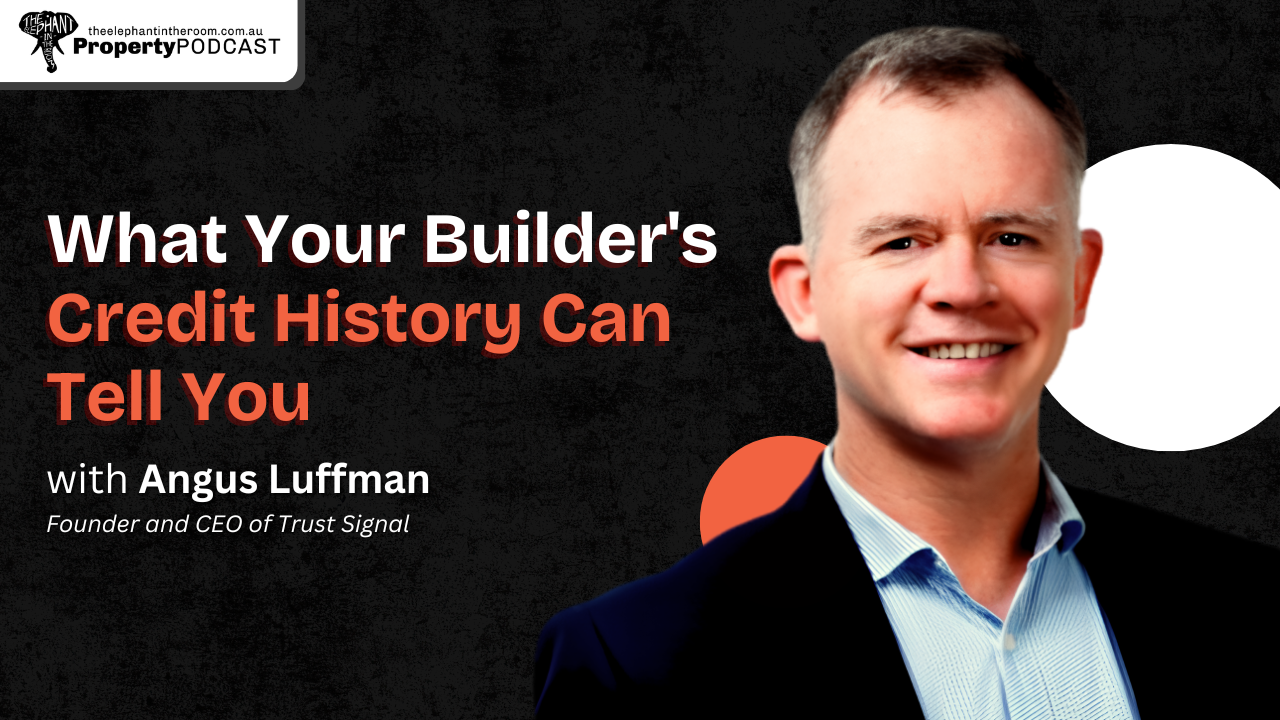

Most people hiring a builder do what feels sensible. They check the license, ask for references, maybe look at some past work. What they don't do, and what the industry has never really made easy, is look at whether the company is under financial stress, carrying unresolved court disputes, or run by directors with a history that would give any lender pause. That gap is what Angus Luffman, founder and CEO of Trust Signal and one of the people behind Australia's first consumer credit score, has spent the past year trying to close. Veronica Morgan opens the episode almost in disbelief that nobody had built this sooner.
Veronica: With so much money at stake and so many builder insolvencies hitting the headlines over the last five or six years, I can't believe that something like Trust Signal hasn't been developed before now. So we're definitely looking forward to this conversation.
Angus: Pleasure. It's great to be here, Veronica and Chris.
Chris: Angus, let's just start with a simple question. What is the extent of this problem?
Luffman's answer starts with a family favour that got out of hand.
Angus: I'll use my own example of how I uncovered this. I was helping a family member late last year doing a check on a builder. We found a provider who could help do that, but I got this very long, convoluted report, a whole bunch of screenshots, and it just seemed a lot more difficult than what it should be. The information is there and available about a building entity, and if you can bring that all together in one place, then pretty quickly you can help the consumer, the homeowner, the tradie, the advisor, understand what that building entity looks like and be in a better position to make a due diligence decision.
That frustration became the product. The stakes behind it, Luffman points out, are bigger than most people register. Construction drives close to 10% of Australia's GDP, about half of that residential, and the sector carries one of the economy's highest multiplier effects, "up to $2.90 of incremental created value happens when a residential builder goes and constructs a house." Around 1.3 to 1.4 million people work in the industry. And for the household on the other end of the contract, the numbers are personal rather than macroeconomic. "That's the biggest investment that a consumer or homeowner is gonna make likely in their life," he says. "But it's also the place where we live. It's our sanctuary." That emotional pull, he argues, is exactly why people skip the basic questions they'd never skip on a smaller purchase.
The record nobody thinks to check
Chris Bates asks whether building the report surfaced anything Luffman hadn't anticipated.
Chris: So when you started building it, was there any things that you sort of ended up building into the product that you hadn't even thought of at the start?
Angus: Oh, absolutely. I wasn't really across the administrative tribunals that sit in various states, NCAT in New South Wales, QCAT in Queensland, and so on around the country. We had a look at a project builder that failed earlier this year, and there were more than 70 tribunal records on that builder. That is a red flag, or at least a reason to ask questions about who have I chosen here, what's going on. A tribunal you're not gonna really know about unless you've been involved in it, and there's about 3,000 of these a year.
Rather than trying to score or rank builders, Trust Signal is built around a simpler idea: surface the records and let the reader ask the right questions themselves.
Angus: We don't score, we don't rank. We just cite what's in the records and bring all those records together so that the consumer or the reader of the report is then in a position to ask the questions. Probably the biggest discovery I've had in this is that the most common aspect here is to go looking for information that doesn't line up. That can be as simple as the decal on the SUV doesn't match the business card, doesn't match the name on the contract. You've probably got a reason to ask some questions, right? Or if you get some avoidance on some questions, you've probably got some reason to ask questions.
Phoenixing, and the two-year director
Bates raises phoenixing, the practice of winding up one company and quietly reopening under a near-identical name.
Chris: There's a lot of talk around phoenixing, right? Does this sort of report highlight if it's obviously a new entity, and they had a lot of previous entities in the past?
Angus: Yeah, it's one of those profile ones, and it's not necessarily easy to uncover, but we certainly pick up some signals on that. The classic financing is company A goes into liquidation, and company B is formed very quickly with a very similar name afterwards. Assets are transferred at low value. So a tell is a director that's really experienced in the industry but has only been a director of this company for two years. That's a question mark, and that's in an industry where 54% of the businesses don't last beyond three years. Absolutely you can't perfectly detect phoenixing, but certainly we go looking for affiliations of directors with previously insolvent companies, and when the company was formed versus what their record might say. There are often perfectly legitimate reasons that people are restructuring their organizations. This is not always the case. That's why we say it's a reason to ask questions.
Asked whether this level of scrutiny is worth it for every kind of build, from an off-the-plan apartment to a single renovation, Luffman doesn't hedge. "If you are going to invest six or seven figures into a building or property, then doing good due diligence is the right thing for you to do, regardless of who's gonna be on the end of the hammer or the trowel," he says. "For a few hundred bucks you can do that and get a lot of information back."
Why builders are riskier than they look
The 54% survival statistic comes from company registrar data, and it sits inside an industry that is, by number of businesses, the largest in the country, a little over 450,000 building companies out of roughly 2.7 million active businesses nationally. Luffman explains why that scale coexists with so much fragility.
Angus: There's pretty low barriers to entry. You can get into it pretty easily, and equally you can get licensed pretty easily. You don't have to go and have large capital amounts sitting on balance sheets. But on the other side of that is just the risk. A builder, someone building your house, that main contractor that's running your house, is operating on a margin that's probably less than 10%, and in some cases can be well less than 10%. They've got cash flow which is highly variable, and revenue that's variable because you're paying them on milestone payments. And in many cases they'll be fixed price contracts where materials could change, and we've certainly seen that over the recent years.
Beyond the homeowner: tradies and advisors
Veronica Morgan pushes the conversation toward the ripple effects further down the chain, subcontractors who've been burned when the builder they relied on collapsed owing them money.
Veronica: I've known subbies that have gone broke. They've gone bankrupt because their main builder they did work for went bankrupt and owed them a lot of money and they couldn't recover from that. Is that something that was in your mind when you built this?
Angus: So again, one of those things we've learned along the way. We started with this classic, the situation I had, and that was really about a consumer. And then along the way this tradie thing came up. It's basically the same report. But that tradie who's committed to doing work often on 60-plus day payment terms, and is then maybe heavily aligned for their work and contracting to one builder, that's a lot of risk to carry. And then advisors are also pretty logical for us, because if you're gonna be signing a contract, you're gonna get someone to review it, and obviously someone like a lawyer is a fairly natural extension of someone getting hold of this report ahead of signing.
The timing point matters most, in Luffman's view. Up until you sign the contract, he says, you've actually got a lot of control, "the ball's on your racket." The moment you sign, a lot of elements become more out of your control. "You've got a contract with a set of deliverables, but you've signed a contract and made a commitment, and so the builder's then in a position to want to make a start."
A New South Wales start, and why banks don't already do this
Trust Signal currently operates only in New South Wales, a deliberate scoping decision rather than a lack of ambition.
Chris: You're only in New South Wales at the moment, but obviously the plan is to try to go nationally. Are you just sort of figuring out all the data points for across the nation?
Angus: Yeah, so that's a bit of an indication of what it's like to put this together. We actually planned to start to do this nationally, but when we got into doing the data work and the testing, it's like every state's got differences. There's differences in licenses, and you've got all the technical connections of course. It was like, oh my god, we'll never finish this thing if we go national first. So we've got the convenience of being New South Wales, the biggest state, it's 40-odd percent of the market. And so we decided to just go with focus so we could get out there and find out about it. There's not a lot of services around this, there's a lot to learn as you go along.
Bates, a mortgage broker by trade, is struck by how little of this banks themselves do at loan application stage.
Chris: It's pretty crazy the banks don't do any of this as well, right? When we do a mortgage application, they're not sort of... they might be doing some checks on the builders, but they don't do a full deep dive like this. How are the banks thinking about this?
Angus: In the end, mortgage lending is an asset-based lend. A credit card lend is about the individual. Yes, they both check the credit file and the credit score and all that stuff, but in the end, mortgage lending is really an asset-based lend, and that's just a practical reality of how those two assets work.
The insurance safety net, and its limits
Veronica Morgan describes the particular anxiety of a renovation gone slow, moving out of a home that's since been gutted, only to find nobody on site because the builder was juggling too many jobs at once, an experience that cost her an extra two to three months on an early renovation of her own. Luffman points to one structural protection that already exists.
Angus: There is a bit of a natural protection. When they go to get their mandatory insurance, in New South Wales that's referred to as HBCF, that's the piece of insurance they must have in place to protect against insolvency, death, going out of business. The insurance policy is there to help the homeowner complete the build, get another builder in. And in doing that, the builder's gotta do a process with icare where they can only have so many of those policies concurrently. So there is a bit of a natural regulated protection there.
On his own renovation, Luffman asked his builder directly how many projects they'd run at once.
Angus: I only do two projects at once, right? And I'll even think tightly if the two projects are super concurrent in terms of the heaviest point of build, what will I actually do there?
What the credit data reveals about suppliers
One discovery came directly from Luffman's credit reporting background rather than the construction side.
Angus: There are elements that sit around, in credit reports, that actually allow you to get a picture of whether this builder has established supply arrangements. You don't necessarily get the names of those suppliers, but actually understanding that there are established supply arrangements, and that they're meeting those supply arrangements in terms of their terms, that's actually an important element. We've got a flag that kind of says, if there's no supply arrangements, you'd wanna ask some questions.
A parallel to credit reporting's own resistance to transparency
Veronica Morgan draws a direct line to Luffman's earlier career, noting the credit reporting industry itself fought transparency before eventually embracing it, and asks whether construction information is genuinely hard to find or simply scattered.
Angus: It is accessible if you know where to look. One of the things we've done with Trust Signal is we've got a public register section of our website, in the knowledge hub. If you wanna go and check this stuff yourself, go for your life. You can't get everything, but you can certainly get licenses and insurances and tribunals and all of those things, and they link through to the government URL about that. It's disparate, and you've gotta know where to look.
Because Trust Signal deliberately avoids a scoring system, Morgan asks how a reader is meant to distinguish a genuine red flag from background noise.
Veronica: How would somebody know the difference between a red flag and an amber light, a red light and an amber light?
Angus: We do an all clear, or something to investigate further, is how we present it on the report. We also ask nine questions and get answers to those nine questions. In the majority of cases there's some sort of data present, sometimes there's not, and that's not necessarily a bad thing. There's no tribunal records, well, that's actually a good thing. It's not every due diligence question you should ask, but it likely will lead to other questions you would want to ask if there's any sort of adverse records in there, or something just doesn't line up.
Where personal credit reporting is heading
Bates, who has his own long-standing interest in credit data, asks whether Australia is moving toward more personalised credit reporting or risk-based pricing as more data becomes available.
Angus: Credit reporting at its genesis was e-commerce before the word e-commerce existed, mainframes at credit bureaus talked to mainframes at banks, to help make better decisions. The transition to positive credit reporting that happened in Australia in the middle of the last decade meant there was about twenty times the data available for decisioning. A credit report used to be a reason to say no. It is now a reason to say no and yes and decide how much. It used to be a decision in less than 15% of cases, and now it's a decision in possibly 80% of cases, because you can get limits and repayment history. That means banks are in a position to get to faster, more accurate decisions, and it can spawn product innovation that benefits the consumer. On top of that, it can lead to risk-based pricing, though we've not seen a lot of that in Australia yet, we don't have the full data set permitted, we don't get balance information here, for instance. Risk-based pricing in mortgages is really done by product variation as against the same product, variable different rates for different risk profiles.
For listeners wondering where to start on their own credit file, Luffman's advice is unglamorous but direct.
Angus: Just get a copy of your credit file. Understand what's on it, because a bank's gonna look at how long you've had that credit file, what are the credit relationships you've currently got, what did you put on your application form versus what's on the credit file. The best place you can start is just go and get your credit file and go and understand it. But remember, it's part of a decision a lender makes, it's not the whole decision.
The property "dumbo"
As the conversation winds down, the hosts turn to a segment they call the property dumbo, a real mistake with a lesson attached.
Veronica: Do you have a good example of a mistake that you or somebody you know has made that contains a lesson we could all learn from?
Angus: I'm careful about dumbos given who my buyers are, Veronica. But I'd say this, just some of the things I've learned along the way. In Facebook groups about building, I came across a story where they'd gone and paid a deposit to the builder because they're an end-to-end builder, and they hadn't even cited or known whether they were eligible for mandatory insurance. It was unclear whether they even knew the maximum deposit rate you paid. Another example was on one of the current affairs shows, a renovation a couple did, where the builder seemed more interested in showing off his organ pipe arms and his washboard stomach on TikTok than executing the build. It ended up with a deck that just wasn't finished, left in a mess. What was really interesting is that only right at the end did the journalist manage to say that the builder was unlicensed. That to me was actually probably the most important point of the story, to say up front. There are simple questions you can ask, and it could have been couched up front that the builder actually wasn't licensed.
Veronica Morgan closes on the theme that's run through the entire conversation: most people simply don't know what they don't know.
Veronica: The problem is if you don't know what you don't know, you won't know which questions to ask. You've come from a background of credit reporting, of asking questions and knowing there is data out there. If you don't think that way, it wouldn't even occur to you. In my business we've got this ridiculously long due diligence checklist, because we know what can go wrong. We still see things go wrong for the first time after 26 years in the business. So I'm hoping the report is educational in terms of the questions that need to be asked, rather than people simply not knowing what to ask in the first place.
Angus: That's how we've tried to solve this, Veronica. We've tried to focus on making it a really plain English, ask the question, here's the answer we see in the data. It's not seeking to be super complex at all, because that doesn't help anyone. There's this information available, we've aggregated it into one spot, we can do it quickly, and we've tried to give you a plain English outcome so you can ask and answer those nine questions. It's not every question, your due diligence list is much longer, but that's what we do.
Veronica: Jolly good. Well, thank you, Angus. It's been a good chat.
Chris: Thanks so much, Angus.
Angus: Terrific. Thank you for having me.
Sources referenced: The Elephant in the Room Property Podcast, Episode 444, "What Your Builder's Credit History Can Tell You," published 6 July 2026, hosted by Veronica Morgan (Good Deeds Property Buyers) and Chris Bates (Alcove), featuring Angus Luffman (Founder and CEO, Trust Signal).
Want more? You can find Episode 445 of The Elephant In the Room Property Podcast here.
Related Recent posts