Curious about upgrading?

Wondering where to start?

Complex questions that need answers?
Is there a better structure for you?










"They managed to navigate my complex expat income and even got my Google RSU income approved as well."
"I highly recommend Alcove to anyone looking for a mortgage broker who is responsive, trustworthy, and truly cares about their clients. Thanks again to the whole team for making the process such a positive experience!"
"As founders, we're constantly jumping between things so having a partner that handled the details & made the process super clear made the buying process breezy for us. Very happy with the experience!"

“It almost felt like it was his responsibility to make it clear to me, not my responsibility to understand it.”
“I've been pretty much fully leveraged the whole time. So the sounding board on that, in terms of what was achievable, what wasn't — I think trust is just built along that.”













"Alcove has been a great partner. They look after my audience properly, keep things simple, and deliver real value. I’ve got full confidence referring clients knowing they’ll get honest, straightforward advice."

"Property is one of the biggest financial decisions people make. Alcove stood out because they take a strategic approach to lending - helping clients structure property and debt decisions in a way that genuinely supports their broader financial plans."


Adapted from audio. This article is a written adaptation of the original podcast episode. Sources and dates are shown with each figure.


Co-host of The Elephant in the Room. Real estate agent, buyer's agent and buyer's agent mentor, co-host of Foxtel's Location, Location, Location Australia, author of Auction Ready and co-host of Your First Home Buyer Guide.

What Was Really Driving Adelaide's Market? Matt O'Donoghue On The Ground
Adelaide kept growing after every other capital turned, and a South Australian buyer's agent explains what he was seeing on the ground. Matt O'Donoghue joins Veronica Morgan and Chris Bates on expat demand, quoting rules and the affordability trap.
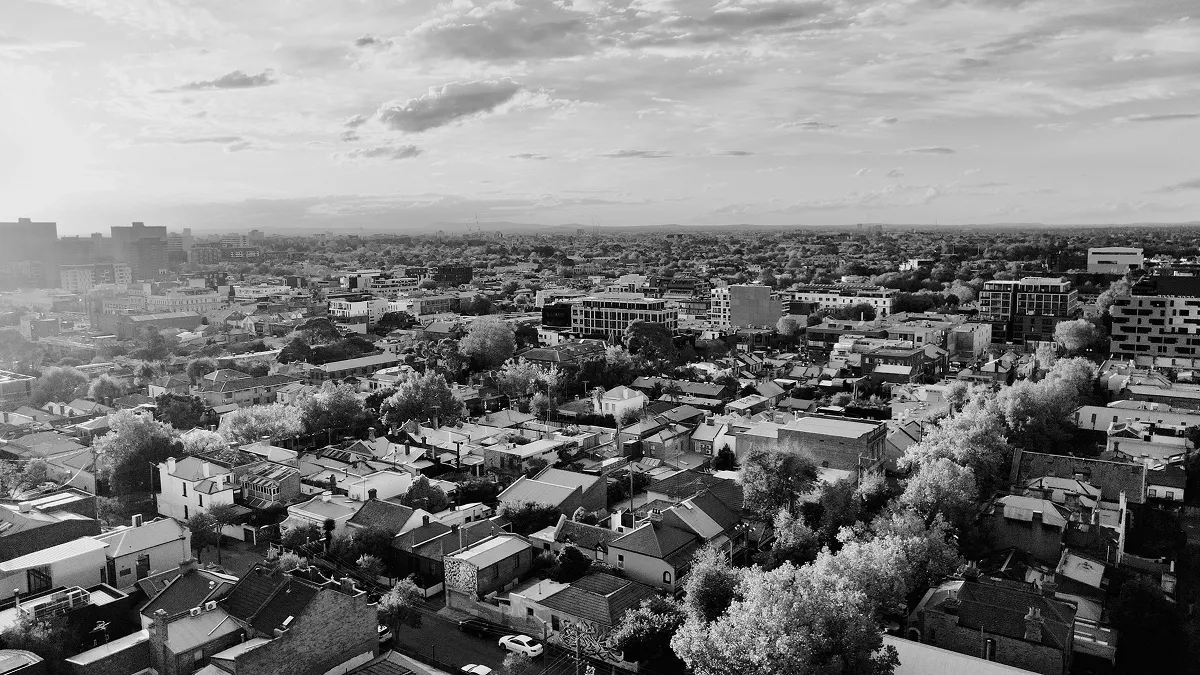
The Adelaide property market has been the poster child of COVID property boom. Prices were still growing for six months after Sydney peaked. They've recorded the lowest rate of price fall since their July 2022 peak and are still ahead against prices 12 months ago.
To top it off, prices would need to fall another 29.4% according to CoreLogic to get back to March 2020 levels. What is the secret?
Welcome to the elephant in the room. This is the podcast where we love to talk about the big things in property that never usually get talked about.
I'm Veronica Morgan, real estate agent, buyer's agent and buyer's agent mentor, co-host of Foxtel's Location, Location, Location Australia, author of Auction Ready and co-host of Your First Home Buyer Guide.
And I'm Chris Bates, mortgage broker, recently ranked number five in Australia out of over 18,000 brokers in the annual MPA Top 100 Mortgage Broker Awards. Before we get started, I need to let you know that nothing we say here can be taken as personal advice.
We always recommend you engage the services of an appropriate and experienced professional.
This week, we've invited a South Australian buyer's agent, Matt O'Donoghue, to join us and share what's been happening on the ground in the Adelaide property market. Matt has been in the real estate industry for almost 20 years, commencing his career in 2004 with Elders Real Estate in the Clare Valley.
And by 2007, he purchased his first franchise on the York Peninsula with offices in Moonta, Wallaroo and Kadena, which I've never heard of, and eventually managed one of the largest franchises in South Australia. So he's pretty well equipped to help us with the market outside Adelaide too, I'm guessing.
But two years ago, he joined the industry veteran Chris Waterman as a buyer's agent. And I must say his timing seems impeccable. Matt, thank you so much for joining us.
We're looking forward to gaining an insight into really what's been happening in Adelaide, but also some of the fundamentals to understand, I guess, maybe how it differs from some of our other capital cities.
Yes, thank you. Lovely to be here. Matt, I think that's a really good place to start, Veronica.
It's just historically what's driven the Adelaide market, you know, a bit of a, you have to go back to 1900, but if we just talk maybe of the last couple of decades prior to COVID, like, you know, what was your trend?
You would have seen some pockets doing well, some pockets doing nothing, some types of properties doing nothing. I think, you know, obviously COVID changed a lot of things, which you can talk about what drove that, but Historically, there was still a property market there.
There were still parts of the market that were doing well, and it'd be interesting just to get your takes on what was driving it prior to COVID. Well, I think Adelaide has always been touted as probably the most conservative city in Australia.
We've had an issue over the last 30 years, 40 years, where we see the young generation all leaving Adelaide, leaving the state. But at the end of the day, we see them all come back when they get a little bit older.
So this conservative city of churches, as it's been touted over the years, has certainly changed since COVID. There's no doubt about that. But really, I think it's a lot of people that have loved Adelaide, born and bred. Expats do come back eventually.
I think they enjoy the hustle and bustle of Sydney and Melbourne on the eastern states. And then I guess when they come to start a family, they move back to Adelaide, I think.
So, I mean, on that point, I mean, so the brain drain, basically, you know, I think, you know, it happens in New Zealand. People come across the ditch sometimes as well, right? They finish their study and they come.
I don't know if that happens as much as it used to, but, you know, but is that sort of, you know, once they've gone and got that expat experience or in the cities, you know, a few clients that have been in those positions, you know,
People from Adelaide wanting to move back to Adelaide, but is it really a lack of jobs though? Because they're super experienced and there's only a lack of jobs that they're going to wait for someone to sort of pass on or a job opening to come up.
But is that sort of some of the problems with the brain drain is that they can't come back unless they want to take a big pay cut or they're waiting for some kind of dream opening? Yeah, I agree.
I mean, that has been the issue over the last few decades, to be honest with you. You know, when you've got a dream, you move interstate at the end of the day, and it's been pretty sad for South Australia and Adelaide, to be honest. That is changing. I mean, we've got some...
Pretty amazing things happening in Adelaide at the moment in regards to the Lot 14 site on North Terrace, which is the old Royal Adelaide Hospital. The changes that are happening there with $762 million of money that's been put in from the government,
as well as $400 million being put in by private sector in regards to innovation, development and research and education, et cetera. It's pretty exciting for South Australia, I think. So all of a sudden that's changed.
There's no doubt that that sort of, I guess, thought process in regards to what's happening in Adelaide and what potential really for South Australia, certainly.
There's been, I mean, the South Australian government for some years has incentivised organisations to set up their head office and, you know, big offices in South Australia. I know Westpac for one has got quite a lot of its staff in South Australia. Is it British Aerospace's head office down there?
There's just two that come to the top of my head. And so obviously that's been in an effort to attract people.
that talent or to give opportunity to people to stay in Adelaide and I would imagine they're not the only ones but also I think anecdotally what you say is very very true I know quite a lot of Adelaideans over the years and I do know that many many many do if they haven't gone back yet want to go back
So it seems to me that there is that sort of real draw card or that draw.
Do you think that, you know, the COVID, the work from home, it sort of seems a bit obvious, but is that part of the reason that it's been so resilient in the face of the recent price falls across the country?
Is that really it does have this latent demand from people who really would live there if they could, and now there's been an opportunity to justify that they can make that
move, would you say that that's behind it or would you say that there's something else driving the attraction to buying property in Adelaide at the moment? Well, affordability for one. At the end of the day, we're still probably the most affordable city in Australia and
The median house price, we're half a million below Sydney and probably 300,000 below. Well, in fact, there's probably more for Melbourne now at the end of the day. But we are the most affordable city in Australia.
I have clients that are looking to get out of the rat race in Sydney and Melbourne and sell their properties in Turack for $5 million, buy the equivalent property in Adelaide for $2 million and put the rest in super or buy a couple of investment properties.
But there is absolutely no doubt in my mind that COVID has actually put Adelaide on the map. There's no doubt in my mind. A lot of my clients are from the eastern states, expats from overseas. I've had clients from Switzerland, France, Germany, UK, America, all expats coming back to Australia.
And basically these people are ex-Adelaideans at the end of the day, South Australians. So there is absolutely no doubt in my mind that COVID has put Adelaide on the map. Are there people that weren't originally from Adelaide though, are they moving there? Yeah, they are, but with friends because of them. Right.
It's true. I mean, I was talking to a friend of mine the other day who moved back from Melbourne.
He has friends that are now, they've come over for holidays to say hello and all of a sudden enjoy the state, enjoy Adelaide, what we have to offer and all of a sudden decide, you know what, I can do my job as good in Adelaide, you know, thankfully with Zoom, of course.
I wish I had shares in that a few years ago, to be honest.
Yeah, and it's just gone crazy right at the end of the day. So these guys can actually set up their own homes, work from home, travel to Sydney or Melbourne if they have to, Brisbane for conferences or whatever the case may be, but everything's worked from home. It's magnificent.
So those people, that biopool, that's a strong biopool, right? I can think of more than five clients that are expats coming back to Adelaide. And in that story with people who are from Adelaide, I've got one at the moment, two in tech.
One, it's, I can even probably say that a lot of people work there, Atlassian. Another one works at a big other tech company. And yeah, they're just looking for a family home and to get that in Sydney, you know, is just enormous. But they know they can get something amazing over there.
And they had a friend move there. And they were visiting her. And they were like, well, you know what? They've got no ties. They're actually both not from Australia. So they've got no family ties. And they visited the friend and then fell in love with the city.
But I mean, the type of properties that they want would also be a bit different to traditional. I imagine traditionally, it's sort of those beautiful... And there's so many beautiful homes in Adelaide. It's got such a heritage overlay around the city, right? Like there's lots of sandstone, you know, bungalows, etc.
You know, it's...
it's got that real facade especially people coming from melbourne they they love that right um but typically they always wanted that maybe maybe around that glenelg to sort of inner city pocket um but do you find that people are now going adelaide hills or down more towards like mclarenville and the barossa or you know that they're willing to to go for that tree change because it's not really much of a tree change it's only what is 40 40 minutes in a car or something it's almost like an outer suburb um
Do you find that that's happening a lot more than it used to? I mean, I obviously think it is, but what do you think? Chris, I promise you, the last 12 months, I've spent a lot of time driving up in the Adelaide Hills.
All the interstate buyers essentially will want to be up in the hills. Yeah. So Crafers, Stirling, because really you're 25 minutes from the toll gates, which essentially is right on the edge of the city. It's very easy to get to.
Everyone wanted to be in the Adelaide Hills, so it's just amazing how all of a sudden I was spending almost eight months of the year driving up and down into the Adelaide Hills. And it's a beautiful part of the world, my God. Mm, it is. Is it that, like, family buyer?
Like, I remember when we went, did Airbnb's, you'd, like, Rosser, Adelaide Hills, somewhere, stay on a boat on the water, like, quite far down south, I can't remember what it was called. But Adelaide Hills is just amazing. But do you find it's the...
that family buyer, because they're living overseas, they're expat, maybe when the kids are young, they like the help, right? And then when the kids are getting to sort of that six to 10 range, that's when they want to get back for the kids' high school.
Is that, or is it a little bit early you're finding it? No, definitely, because I've got a client right now that's looking up in Stirling, small family, bit of acreage, swimming pool perfectly for the family.
I had a client of mine, an expat from Singapore, specifically looking in the Adelaide Hills to buy, but moving back in three or four years' time. So it's just securing a property now to move back to in a few years' time. So
Uh, I've seen a lot of that as well because that, you know, their potential, they are seeing, sorry, they don't have any kids at the, at the moment, but that's their plan also at the end of the day. Yeah. So yeah, we're seeing a lot of that, definitely.
Uh, but it's, it's ironic that you met, you asked that question because I, I was just saying to someone the other day, just how much I've been traveling up in the Adelaide Hills plate. So it's a popular area, I promise you.
One of the things that we often see, and particularly Brisbane, you know, there's always been a bit of a migration north from certainly from Melbourne and from Sydney too to a degree into Brisbane.
And a lot of the Brisbane buyers agents will comment that southerners tend to gravitate to the sort of property that a Brisbaneian would not go for necessarily. You know, we like brick and tile down here and they like timber and tin up there. Yeah.
Do you find the same sort of thing in South Australia? Do you find in Adelaide when people come from elsewhere that they do gravitate towards the sort of property that or even an area?
So like in Brisbane, for instance, there's these places on the river that people from South would think, oh, well, they must be good because they're on the water, but they're actually not great suburbs in terms of how the locals will perceive them.
Would you say that there is that sort of trap to be fallen into by interstate buyers in Adelaide as well? And where would that be? Like, where would people gravitate where locals will go, no, I'm not going there?
Well, at the end of the day, I think there's a portion of Adelaide from Norwood that runs all the way around to Goodwood, which essentially is the eastern, the southern parts of Adelaide, within the 3 or 4K radius of CBD. That is the area where everyone wants to be.
But having said that, they're also actually put back in their place, I think, by their expectations and what they can afford in their budget, obviously. Because that's actually, I mean, welcome to the world of buyers, but basically that's where everyone seems to want to go at the end of the day.
Yes, you've got those that want to be down by the beach, of course, and that's fine. The thing about Adelaide is, what's unique about Adelaide is that we're in between the hills and the sea. And so what's happening in Adelaide is we've just got this urban sprawl happening from north and south.
So everything virtually within the hills and the beach is becoming as popular and it's driving prices up. There's no doubt about that. I think the perception of what they can get for their money now is just a hell of a lot different than it was
But is that something that then becomes a problem for locals? So if you've got a lot of interstate or people returning or following their friends to Adelaide, does that mean that we've got expats or interlopers pricing out people that have stayed there, the locals that are in the market? Yeah, definitely.
And that's where they get on the phone to the buyer's advocate, to be honest with you. Right. So they want you to work a miracle. Yeah, that's right. Of course. Yes, exactly. And they do.
We've known for years, I guess, at the end of the day, the way that we were brought up is that if we see a price for $800,000, we're going to go in at $750,000 and negotiate.
Right now, 18 months ago, if I saw one at $800,000, my first bid at auction would be a million dollars straight away. And that's the market. That's what's happening here in Adelaide at the end of the day. The locals just don't understand what's happening with pricing here in Adelaide.
It's very confusing for everybody at the moment. But as a buyer's advocate, you're on the ground 24-7. You just sort of know it.
So you think that the locals though, because it happened in Brisbane as well, I think, you know, it was always the Brisbane's got to boom, Brisbane's got to boom. You know, every property, magazine, even though you shouldn't read magazines in property, but anyway, was a Brisbane's got to boom.
And a lot of that was the people in Brisbane didn't want to, you know, buy, take on a bigger debt and then, you know, the property not go up, right? Especially on a higher interest rates. But then there was that fear of FOMO, right?
The market is, and actually I need to upgrade because I might miss the boat. And do you think that that sort of happened in Adelaide as well? Like people were like, oh yeah, it's okay. I'll upgrade when I get to that stage of life, when the kids are 10, right?
When I need that space. I'm not going to upgrade now because I'll just buy it in the future. It's not going to run on me. But in the last two years, they could feel that that gap ran on them because the bigger places obviously went up the most.
And then the locals started to have to really come in under lower rates because there was that FOMO that they might not ever be able to upgrade one day. It just astounded me, that FOMO. You know, I guess that was everywhere in Australia, you know, post-COVID. Yeah. It was amazing.
I couldn't believe it. You've got clients that would say, look, I know I'm paying $300,000 more for this, but I want this property now. I'm going to buy it right now. Whoa, okay, well, it's your call at the end of the day. But this fear of missing out was just crazy.
You know, I think – sorry, Veronica, but the – What I would embrace is just auctions. Bring the auctions on at the end of the day because that will tell you where the market is, basically.
I've got a good question on this because, okay, so have you never experienced that in Adelaide market before? Is that the most intense that you've experienced that? Yeah, I think so, probably. And of course, yeah. Sorry, there'd be young agents out there just going, God, how good is this? Of course.
This has got to be the easiest gig in the world. I mean, to be honest with you, without being derogatory towards agents, Bozo the Clown could sell real estate the last two years, to be honest with you. If you're an exceptional lister, it's sold, basically.
So, yeah, it's a wonderful world for those youngsters in the market. But as soon as that turns, you know, we'll see what happens, I guess, at the end of the day.
We see that regularly happen in Sydney, don't worry, where, you know, all the fresh influx of new players in a hot market and it's easy. And then you'll see who's really made of substance when things get tough. Nobody is stuck going back on the market again.
Yeah, the auction market down in Adelaide is different. I mean, it's never been perceived as an auction market. And obviously, when you've got lots of competition, the opportunity for agents to sell an auction campaign does present itself.
Now, I know the quoting laws in South Australia are different to how they are in other states. There's one, and look, they're all different. Every state and territory has different underquoting or different property laws.
But particularly with underquoting. So I'm really keen to understand how this works in practice, because I think it's pinning what the owner can set the reserve to what the agent can quote is probably the safest way of trying to eradicate underquoting.
Because then it avoids that collusion that sometimes agents and vendors have where the agent justifies to the owner why they need to quote low. And so therefore, if you've got that level playing field across the industry, it's going to give buyers more confidence and there's a bit more consistency.
So that's my sort of theoretical understanding of it. How does it play out in practice? Well, to be honest with you, I think buyers don't know this. Right. That's the biggest issue, I think, at the end of the day. Wow. I will say to them that, okay, so they're quoting $800,000.
Okay, well, let's just add 10% to that. So we're talking $880,000 is the reserve price on that. Oh, are we? Oh. So they don't know. They honestly don't know.
So what do they think? Well, the issue is that they still have this mentality of $800,000. I can get it for $750,000.
And then I'll go in and be the first bidder at $1 million, and everyone just looks at me and goes, oh, God. And I've just dropped 85% of the buyers out of the competition. It is great, though, I must admit. I think the issue that we've got in regards to this pricing issue...
is it's very easy to be able to put a price on a property when you look at Price Finder and CoreLogic, possibly historical data in regards to this with the price estimate that they put this property at.
I can use that as a justification as to where I'm going to put this price on the market. And we know that it's going to be higher than that. I totally know that it's going to be higher than that.
And when I speak to my clients, I say, well, look, Matty, this one's perfect for us. Well, we need to put another $200,000 on it. Oh, what?
So a lot of people are even going to the bank and getting their finances in order, and all of a sudden, I'll just go in there and pick them on their first meet.
And it's just driving people insane, hence the reason why they actually do come to me eventually, or to a vice agent in Adelaide, obviously, to get a better understanding of how this works. But I love it.
I do love it because we just know that if there's a price there, 10%, if we go over that 10%, we know that the property's now on the market and bring it on. So I don't mind it.
I'm presuming that you've got a process of researching the price so that you can arrive at whether that's appropriate or not. Like, I mean, cause I mean, I know we sort of talking shortcut here or shorthand here because you and I both been in industry for a long time.
So I'm just wanting to make sure that we don't leave our listeners thinking that you just throw a dart at a dartboard and decide you're going to, you know, blow them out of the water. Cause you happen to know that the reserve is going to be 10% over what's guided. I mean,
How do you then say, like you gave an earlier example, I'm guessing it's hypothetical, but if they're guiding eight that the reserve can't be any more than $880,000 because that's your 10%, local buyers will be thinking, oh, maybe I'll be able to get it for $750,000 because they're not yet sort of well-versed in this auction thing.
But interstate buyers coming in won't necessarily have the same thought process. But are you using comparable sales to arrive at the figure that you're recommending or
be more about um okay what competitive or tactically how can i make sure i secure this for the client well i think obviously comparable sales is very important you know you you know as a buyer's advocate you need to know what's happening in the market in every suburb obviously so at the end of the day yes you do comparable sales yes you speak to agents you find out what's happening in the market in regards to the pricing um but i think what's important is because you're doing this 24 7 you just know the market ultimately at the end of the day
There's no way in the world I would probably do it now, even though the demand is still strong. We've got a bit of an issue with stock. So the status quo virtually remains the same. Even though the demand is lower, the stocks are lower. So the status quo remains the same.
Would I go ahead with a million dollar off on an $800,000 property? Probably not. Not in today's market. Not now. Because, you know, I might be the only bidder and buyer and then all of a sudden I go, oh, hang on. Why did I collect too much? Yes. You feel very comfortable.
No, no, no, no. So yeah, it's different. I mean, I had a client from Melbourne. He was coming out, well, he was buying a property for his daughter. And he was a veterinary surgeon in Melbourne, just outside of Melbourne.
So really didn't know Adelaide at all. He would fly into Adelaide, go straight to his motel room, go to the conference, go to a hotel, get on the plane and fly home again and never really understood Adelaide.
He came across and I showed him this property and he just went, oh my God, two Ks from the CBD. I keep throwing up this $800. This was $800, by the way. And I did go in at $1 million. I said to him, we'll buy this for $1.2 million.
He said, are you kidding? Is that all? But that's the danger of coming from a more expensive city though, right? Right. So, so one point I did, I literally bought it for 1.2 million and, uh, and he was on the phone. He was back in Melbourne.
He was on the phone when I was doing the bidding and we were, you know, the highest bid over 1.2 and he's got 1.225. I said, no, no, no, it's okay. We've, we've, we've got it. It's us. It's us.
See with him, he would have just gone further and further because he didn't believe what you were getting for the money. Two Ks from this in only two Ks from yeah, CBD. So it's a different market now than, than it was. So.
So you've got like two, obviously, I do think the expat people moving back, people who have prospect from Blades, you know, they're coming back and look at the alternatives, especially people who've worked in oil and gas and things like that.
Maybe they've, you know, they've gone and worked in around the world and then maybe there's, you know, good jobs in Adelaide for that. And so I do think you're going to naturally get that.
Because, you know, staying in Sydney, Melbourne or Brisbane, you know, especially when you get to the family stage before your family are back in Adelaide, it's not as easy as sort of it sounds and it's no more affordable. So I think you're going to get that.
But are the locals starting to feel like the income growth Because prices are determined on how much money people can borrow and how much debt people want to go into. So the last few years, the big jump in prices, a lot of locals are feeling that things are getting quite expensive for them.
So it's not the new money coming back, like the expats that are on decent incomes and bringing cash because they've saved money. But the locals that are on local incomes, are they finding it's starting to get a bit of a stretch unless they're super cashed up or they're on a really high income?
The majority of the city is starting to feel a bit like it's had its day, it's had its growth. And it's only these pockets that are now getting driven by low supply and higher incomes and cash that are really starting to keep, you know, buck the trend and continue to go up.
Yeah, I think there is that nervousness there now, no doubt. And I think, you know, we can thank the media a lot for that as well, by the way. Yeah, but, you know, because they need negativity in the media, of course, and so they sort of drive this a bit.
But it is certainly a concern for everyone at the end of the day. You know, everything's going up. Water, power, everything at the end of the day. And so with all, you know, what have we had, eight or nine interest rate rises? So the nervousness is definitely there, I think.
The affordability, but the affordability is... still very good ultimately so you know if you're buying two or three million dollar properties and one would assume that you're actually in that market and you can afford it essentially
I'm on a personal mission to help more people make better property decisions. And you can find out all about what I'm working on at veronicamorgan.com.au.
And there you'll find resources for first home buyers, details about my buyer's agent mentoring program, access to suburb help for investors, or if you're looking to buy your dream home or an investment property in Sydney's inner west, eastern suburbs, or lower North Shore, you can connect with my team at Good Deeds Property Buyers.
If you're thinking about buying your first home, upgrading to a new one or purchasing an investment property anywhere in Australia, we would love to carefully guide you through this journey and importantly, get the finance right. Please reach out via our website, wealthfull.com.au.
Don't forget that you can download our free full or forecaster report. Which experts can you trust to get it right?
Affordability is a relative concept, though, isn't it? And it's relative to what you're earning. So I guess if that is sustained, whether people are moving back there or moving to Adelaide are able to maintain their higher incomes, then that is sustainable.
And the locals on local incomes, if they are substantially different, will be suffering a bit. But let's look at the investor side of things, because in a lot of property forums, you know, there's Adelaide's been talked about in glowing terms, so is Perth.
And, you know, that always worries me, you know, when investors on forums are talking up an area. Have you noticed an influx of interstate investors? Absolutely. What's going on there?
Well, I think I mentioned it to you before, Veronica, you know, I just know when I get the phone call, when they've got the five basic questions that they ask. Right. Okay, well, I think I know where this guy's coming from. And, you know, essentially they're saying that you've got to look for...
Three bedroom, two bathroom, no less than 500 square meter of land with a 10K radius of the CBD, you know, and see if you can get that for about $350,000, $400,000, and then I'll just go, please, sorry, you've been fed the wrong information. In la-la land. Oh, my God.
Well, it is, and we get a lot of it, ultimately. You know, they say, these are the questions you've got to ask the buyer advocate, and you've got to try and screw them down as much as you can, blah, blah, blah. And that's fine. Of course. We'll bring it on, of course.
But, you know, at the end of the day, you've still got to educate them. And they're a little bit shocked. Oh, my God. Fuck you. So this sounds like, to me, a situation of asking the wrong questions.
So they've got their five questions that they've found out on some forum or they've been following someone on YouTube or whatever. And so they've got these five questions that they deem to be, you know, the key questions that investors need to ask.
You as a local, as someone who's had only 20 years experience now, I think, hang on a minute, they're the wrong questions. What mistakes would they be making as a consequence of going down that path versus what you would say to them that they need to be considering?
As you know, it all comes down to budget, basically. You know, if they're looking for a three-bedroom, two-bathroom property with no less than 500 square meters of land, with a budget of $450,000, then we're going far north or far south.
So, you know, from their forums, they'll come back and say, you've got to be within a 10 or 15K radius of the CBD when you're just explaining to them, seriously, that's not happening. I promise you it's not happening. So you've got to educate them, basically.
But would you say that, is that a good investment? Like, would you be recommending somebody go that far out of the CBD in Adelaide as an investor? Well, I would, because I think the further out, the better the yields, ultimately.
But there's certain areas that you probably, as an investor, you wouldn't steer towards because you've got to consider the tenant, basically. Um, so there's obviously some areas that have, you know, not as lovely as others ultimately at the end of the day.
So, but these areas have got massive growth, you know, um, these, these areas North or South of the CBD. But what do you mean by growth? Uh, prior, you know, there's some areas like Elizabeth and Salisbury that are, that are up. I mean, prior to COVID, Adelaide's gone up 44% approximately.
Yeah, but that's an aggregate of the whole city. I'm sure not everyone's done, not every area's done that. No, correct. But actually north, like Elizabeth and Salisbury is actually where the most growth has been. So there's some areas there where you would go and there's some areas that I probably wouldn't stick anymore.
Why would you say that is? Elizabeth's where Holden used to be, right? And so when they closed, I mean, was there a period of time where really that market really dipped and so there's a recovery that counts for part of it? Possibly.
I think, I mean, it was doom and gloom when that happened, certainly. But once again, it's just affordability. It's always been a very, very affordable part of Adelaide, really. So do you think that that's driven partly also by the rental crisis that we've got across this country?
So affordable areas are typically areas where you might have a higher proportion of renters, possibly? Yeah.
And so that's going to drive yields up, obviously, because people are going to go there and that's going to bring investors in because they're going to make the erroneous.
And I guess you can have a bit of a false positive in a way because it's driven by external factors that have got nothing to do with the intrinsic characteristics of that area.
And people could be lulled into a false sense of security thinking that that is actually what's called fundamentals of an area, but it doesn't actually have them. Is that a risk in a place like that?
Possibly, but I think at the end of the day, once again, it comes down to the affordability of those properties. And that's where these first-time investors are going, are leading towards, where you have some affordability ultimately. Yes, but that's a short-term factor. What I'm talking about is long-term.
They buy in there because they're affordable. It's made to look even more attractive because there's a rental shortage and rents are going up.
And also they're comparing it with more in-demand homes. Like you talked about that area that's stripped between the hills and the coast, basically, in sort of a three-case of the Adelaide CBD that's always in demand. People who can't afford that will go elsewhere. When there's no demand, what happens to the affordable areas?
I count wealth at the end of the day.
couldn't tell you to be honest with you. I mean, I, I just think that the, with what's happening now in Adelaide, the, the demand is strong in all areas, in every area. Yeah. Everywhere, everywhere I see the, there's strong demand everywhere I see at the moment. Yeah. Um,
I guess that's, I mean, I look at that and just think, oh, I feel it's risky for people buying in when there's an area, this city that everything's got demand. That means that it's like in a hot market in a great suburb, the stuff on the main road will sell fast.
well in a hot market, but you know in a slow market, no one's going to touch the stuff on the main road. And if you extrapolate that concept into a wider area, whether it's just a council area or whether it's a city, the same principle applies.
The stuff that only sells well because everything's in demand, as soon as demand shrinks, that stuff gets I don't want to be on the main road now. I'm going to go back to the A-grade areas. I go to where I perceive I can afford.
So that's the problem with that affordability as a driver. That's what I'm trying to get at here. And I guess if I lift the lid on your answer, I'm guessing that because, like you said earlier, you've never experienced a demand of this magnitude in Adelaide and so widespread before.
So when you say you don't know what's going to happen when it evaporates, it's probably because you haven't actually – had that happen yet. But in regards to these investors, like every other investor at the end of the day, they're looking for capital growth and yield, basically.
And for the analogy, if you drop the pebble in the middle of the pool, the higher energy is at the beginning of the ripple and then it falls out of the... Yep. So look, with these investors from these forums that come forward, yes, we're going to be steering them out for north.
There's no doubt about that. Into what's basically affordable, very good yields and potential for capital growth ultimately, I think. Yep. From a low base.
So I think that the issue with driving buying affordable properties is the reason they're affordable is that ultimately the fundamental demand is the affordability market, right? People on lower incomes and middle incomes, the reason they're living there, not by choice, 100%, it's because that's where their income can afford.
And same as an investor, it's affordability, right? I can't afford a million dollar investment property, I can afford 300, so I'll buy that. We talked about at the start of the podcast, we talked about demand in terms of who's driving the Adelaide prices. Well, the expats coming back,
they're not moving to these areas, right? High income, cashed up expats aren't moving there. Also the people in Adelaide, the business owners, the execs, the high paid jobs, they're not moving to these areas, you know, and wage growth is not equal.
So, you know, a small portion of the people in Adelaide are doing much better than the majority. And so what you'll see is the income growth is not fair in Adelaide. Income growth's probably really strong in that middle one to 3K ring around the city, which you just spoke about.
They're the ones getting the 30K bump in salary. They're not getting a 3% pay rise, right? And in those areas, you're getting very low supply because people aren't selling, right? Because they've got their forever home
they don't want to move anywhere else they can move another kilometer off closer to the city but there's no real advantage so we just say this you've got this ultimately this shrinking supply and growing demand every year the problem when you go to those outer areas is you just start seeing more more supply right you'd be seeing house and land packages you'd be seeing duplexes you'd be seeing townhouse you'd be seeing apartments etc and and that's where you just yeah you're getting good yields but the growth is not going to be anywhere near where income growth is in adelaide and i think
That's the issue with these property forums with Adelaide is that they'll push people down these affordable... And the issue is they haven't thought, what's the alternative? What happens if I just bought one, not three?
Or what happens if I sold that other one I bought in Perth or Brisbane apartment and then bought one really good one in Adelaide? Or what happens if I waited to get that pay rise?
And what happens if I included my partner in this or paid off my HECS debt or didn't have that credit card? There's not enough critical thinking to it. They...
the the forum says where's the hot spot where's gets good yield okay you need to go to adelaide because there's good yield there and then they get shifted to these affordable markets and then you know they come in your your door and they'll say i want to buy something three four hundred you you're not there to drive that conversation it's just that they've come to you as the final stop to get the the transaction done but all the wrong questions and all the wrong thinking started many many months before you um
And it's hard for you, and this is one of the challenges with buyer's agents, is you get the brief, you get the budget. Often buyer's agents don't know if they're pre-approved and what their maximum is because the client is a bit cagey. They're like, do I trust the buyer's agent?
So tell them it's $500.
Or they could go to, for a real cracker, they not only want to spend $500- Yeah, it was just driving me insane that, you know, I've literally got a client right now. Sorry, Chris, but the other thing is that, you know, this investment caper is a long-term strategy. Yeah. Yes.
They're not going to do this in two years and make $100,000 on their purchase on this. Oh, yeah, but they all think that they are, don't they? Because there's this instant equity uplift thing that's being touted.
I mean, if you talk about certain budgets, I've got a client right now that's a bit of a bug. Matty, million dollars. Come on, Matty, find me something for a million dollars.
Anyway, I found something and I thought, well, at the end of the day, unfortunately, it's not within our budget, but it absolutely ticks every part of our brain. We've just put an offer in at 1.6. Others go, are you serious?
I mean, I would have been looking at a completely different market. Yeah. Yes. Yes. Yeah. But, you know, obviously they want us to, you know,
That's a really interesting conversation. So we do a lot of this. We do scenario analysis, right? And, you know, and it'll be, okay, so if you sell that property, you can, if you don't do anything, you can borrow X. If you sell that property, you can borrow Y.
If you sell both those properties, you could borrow Z. You know, if you did X, Y, Z, you could borrow a bit more. If you waited for this to change, like, et cetera. And, you know, unfortunately, like not many people go through that analysis.
They just go, like, tell me what you want to spend. Oh, 1.1. okay, cool. Yeah, that's fine. We can do that, you know? And even today, like a client was limiting themselves up on the central coast.
You know, there was, it was just like, probably not like just, oh, we haven't got kids yet. It was just one of our first property. It is our first property actually. So we don't want to go too far in.
And I don't, I think it's less risky for me to spend a little bit less. So I'll just buy this little townhouse. When literally 15% more would get them a 600 square meter north facing on the best street. And so, and what was happening is their search asked us what we're doing.
Oh, well, we really limited our search to 1.1. And this is the best that we could find under that. Whereas if you change the search to 1.4. It was like in the last 12 months, you're like, well, there's six properties that are crackers that have sold.
So I think, yeah, buyers have got to be very careful with self-limiting their options because end of the day, you're just literally limiting your opportunity. And sometimes you're really shooting yourself in the foot because in Adelaide, there's sweet spots in the market, right?
Like, I mean, there's probably points where the locals don't want to go past. Like they just haven't got the income or the tenacity to go past 1.5 million. Maybe there's like a mental...
like limit but then if you went two million you get 40 more land the best street the heritage frontage the tennis court and so where is that sort of in adelaide like where in sydney it's probably you could probably tell that is so far i reckon it's probably five to four like four and a half to five you start getting you know maybe much properties in three i don't know what do you think like it's a
Sydney's a really hard place to talk to that because in the inner areas where your dollar per square metre in terms of land is most expensive, you're getting not a lot of house for a hell of a lot of money.
And then you go into different suburbs, you get different lot sizes, different types of houses. So, you know, in one area to say that you need four and a half to five million dollars to buy a decent house is sort of crazy because you think you don't need that much at all.
But in other areas, if you don't have that much, you've got bucky buying something unrenovated if you're lucky, you know, that you can barely live in. I guess at the end of the day, the median, what is the median in Adelaide? It's about 700,000 now.
You know, I live in a beautiful area here in Adelaide, in Hyde Park. There is Unley Park, Hyde Park, Malvern, you know, the foothills leading up to the Adelaide Hills. They are commanding good money.
But at the end of the day, good money here in Adelaide is a pittance in Sydney and Melbourne, potentially. So for $2.5 million, you can actually get a beautiful home, a beautiful home with 900, 1,200 square metres of land.
Um, the closer you get to the CBD, of course, to cash from the CBD, um, you know, there's Victoria Avenue here in, in Adelaide Park where you'll be paying or losing, you'll be paying potentially 9 million, 10 million. Um, there's not too many areas like that in Adelaide, however.
So we've only got this, this small areas where, where it's commanding huge money, ultimately. Yeah, I think your example there of that client, though, that sort of comes to you with a self-imposed limit that is more arbitrary than real.
And then when they see the house that they want, they're capable of paying a lot more. They never told you that. So therefore, you're searching for the wrong property and you don't even know it because you're only focusing on the information they've given you in the first place.
And then when you go and make an offer on the more expensive one, you think, God, there's five others that they could have looked at that they might have actually liked better. Hold on. This seriously does drive me insane. So that is your budget. Okay, that's what we're working on.
Okay, well, that's the area that I'm going to be looking at. These are the areas that we'll search. These are the attributes that I'll be looking at. Perfect. Okay, let's go 100 miles an hour. And then it comes to the crunch where they've all of a sudden got another $400,000 up their sleeve.
It's like, Is it something that comes particularly with interstate because there's this perception of you can get so much more for your money in Adelaide and so therefore they might even limit themselves as well by thinking this sort of bargain mentality? Or is it something that you struggle more with locals?
No, I think it's across the board. Buyers want to save money and sellers want to make money. But ultimately, it's across the board, to be honest with you. It just varies. So have you got an example of a property Dumbo for us? Or is that it? I don't know. I'll give you one.
Hopefully it's not too long-winded. But there was a property for sale at auction. And I won't mention the agent or I won't mention anything. But ultimately, I had a client, we had a budget, and we made an offer.
Because what was happening in Adelaide, you could miss the property on a Wednesday, do the first open on a Saturday, and you sell it on a Sunday. Because basically, that's what happened. And so we've inspected the property. There was 10 offers that had come in the next day.
So we made an offer on the property at $1,248,000. Sorry, let me just step back. The agent said, okay, all offers to be submitted by 6 p.m. on a Thursday night. And I'll explain why I think that's just crazy. So 6 p.m. on a Thursday night.
So we put our 1, 2, 4, 8 in five minutes to six. I didn't get a phone call until quarter to nine to say, okay. And this is the phone call that said, okay, now look what you need to do. You need to weigh the cooling off on this. And I've gone, okay.
So does that mean that I am the winner? Am I the highest? Well, what you do need to do is just wave the cooling off. Now, I understand that, but am I the highest? Am I the highest? Well, you are at the moment. You had a deadline. What do you say?
And look, at the end of the day, on a Thursday night after nine o'clock, for me to try and find a solicitor, he's probably in his second bottle of red in a restaurant somewhere. I've got no hope of them sitting down to do an hour-long wave of cooling off right now.
So we had to do it the next day. And I said, well, so I'm not, so I am the highest. Okay. She said, but who's to say that someone doesn't, she's going to love this. Who's to say that someone doesn't call me at 6.30 in the morning with a higher price?
I said, oh my God, this is sounding a little bit unethical. Anyway, I will organize to get the wave, the cooling off first thing in the morning. And I've told my client and she's a bloody ill man. What the hell?
and this is true so anyway at just after 6 30 the next morning i'm just made my cup of tea i'm just about to sit down and my phone rings now and it's the agent and i'm i looked and normally i would say good morning matt matt speaking but i was probably still wiping the sleep out of my eyes right so i'm just going hello anyway the agent said now look i'm just having trouble reading your text are you saying one three three one
And I just stopped for a second and then said, uh, excuse me, do you know who you're talking to?
And she's, oh, that's Matt, isn't it? I said, uh, yes, it is. So hang on. So what you're telling me that someone has just made an offer of 1,331,000 on this property. Um.
Uh, yes. I said, oh my God, are you kidding me? It's almost like you predicted this. This is outrageous. So, you know.
And just to top it off, she said, she ran back again at 9.30 and said, okay, now what I'm going to do, I'm going to take best and final offers by 10.30 this morning. And I said, whoa, are you kidding me?
I said, is it only against me and this other person I'm assuming? And she said, yes. Well, I already know what they've made, their offer they've made. So I'm not, and in fact, 1.248 was our maximum minimum. So I said, you know what, it's unethical, I'm not doing it.
And as I learned, three months later, that buyer bid themselves $1,000. So they actually outbid themselves again when I stopped. So it was just outrageous.
So essentially what I'm saying is if an agent is going to do a best in final, it's got to be by three o'clock in the afternoon to give us time to be able to go and wave the cooling off if it's an ad auction.
It was just amazing what happened at the end of the day. And this is an agent that's been around a long time. I guess this is a good example of agents who are not used to dealing with volume of buyers, this level of competition.
They don't have a process in place to say, this is what we're going to do under these circumstances. It reminds me not quite, I've never bungled up anything quite like that. I don't think when I was a sales agent, but early on.
I remember not knowing how to handle people throwing offers at me and having to be coached through by, you know, my boss. And so that sounds to me like also, you know, best and final and then, oh, another best and final.
How many best and finals are you going to give us in this exercise? So... But when I first started in real estate, I was doing the C4 course, right? And at the course, you have guest speakers that come in. And I remember this guy, an older gentleman came in.
And the first thing he said, I've been in real estate for 35, 40 years, and I can promise you that every day is not the same. And I learned something new every day. And I just went... It's so true in real estate. There's something in you that pops up just about every day.
And what you have to do is you've got to put it in your memory bank and know how to deal with it once it pops up. So it's an amazing industry. There's no doubt about it. It's not easy at the end of the day.
And I think you've got to be on the ball at all times. It's one of the reasons I put together the Buyer's Agent Mentoring Program. Exactly that.
Weekly sessions the other day, we were talking about one of the members was saying, you know, I've been approached by somebody who wants to buy a withdrawn listing. So this property's been to auction, been passed in, and then ultimately been taken off the market. And I'm like, all right, okay.
So, you know, because of my sales experience and all my buyer's agency experience, I pretty much can almost tell what's happened in the scenario.
And so I have a hypothesis and then I set up a whole bunch of questions that I would go to the original agent and the owner, wherever I've got access to that property. And you've also got to make sure that the buyer doesn't run the risk of paying two commissions.
There's actually a deal to be done. There's a whole bunch of things. That through experience, you can string it all together and say, right, this is how we move forward.
Whereas if you haven't been around the block, everything is new and you can't draw on all of those things that have happened over the years to go, right, I get. And also, sometimes there's no deal to be done.
Sometimes you beat your head until it's a pulp against the wall and you're never going to buy that property. And a lot of time is wasted. But, you know, early on when you're naive and starry-eyed, you'll go for it because you want to show how good you are. Yeah, that's right.
But I think, you know, as an agent, as a selling agent, or even a buyer's agent, at the end of the day, advocate, You know, to align yourself with a very good solicitor or a very good conveyancer that you can bounce off every single day is gold, I think. Very helpful.
Yeah, it's absolute gold. Because, you know, you get the right person that, obviously, if you feed them enough business, they'll come back to you, you know. And, you know, I've had a few of those over the years that have just been, you know, fantastic for me.
Very true.
Thank you, Matt. Really appreciate the chat. Interesting just to get some more insights into Adelaide. It is a market that we don't have talked about in depth that much on this podcast, but certainly we're recording this in February.
The results, you know, certainly the data in February has continued to show Adelaide to be basically the strongest performer in Australia probably throughout 2022. So it's time that we had a conversation about it.
Bucking the trend, I think. Awesome to chat, Matt. Thanks for coming on. Thanks very much, guys. Cheers.
If you have a question that you'd like us to answer in an upcoming Q&A episode, you can send us a voicemail or written question via the website, theelephantintheroom.com.au, or you can email us directly at questions at theelephantintheroom.com.au.
If you like what you're hearing, please share this episode with others you feel would benefit. And while you're at it, why not leave us an iTunes review? Five stars would be great.
I know that sounds a bit cringy, but we have it on good authority that every review helps make it easier for other people to find out about us and hear what our amazing guests have to say.
Key takeaways
- Veronica Morgan opens with CoreLogic figures: Adelaide prices kept growing for six months after Sydney peaked, and would need to fall another 29.4 per cent to return to March 2020 levels.
- Matt O'Donoghue puts much of the demand down to returning South Australians, with clients coming back from Switzerland, France, Germany, the UK and America.
- Interstate buyers gravitated to the Adelaide Hills, with Crafers and Stirling about 25 minutes from the toll gates on the edge of the city.
- South Australian quoting rules tie the guide to the reserve, so a property quoted at $800,000 cannot carry a reserve above roughly $880,000.
- Veronica presses the point that affordability propped up by a rental shortage is a short-term driver, not a fundamental of an area.
- Matt walks through an offer deadline that unravelled overnight, from a 6pm cut-off to a rival bid at 6.30 the next morning.
Why Did Adelaide Keep Growing After Sydney Peaked?
Veronica Morgan sets up the episode with the numbers that made Adelaide the outlier of the COVID cycle. Prices were still growing six months after Sydney peaked, it had the lowest rate of price fall since its July 2022 peak, and was still ahead of a year earlier. On CoreLogic figures she cites at 0:17, prices would need to fall another 29.4 per cent to reach March 2020 levels.
Matt O'Donoghue, a South Australian buyer's agent of almost 20 years, starts further back. Adelaide has long been touted as the most conservative city in Australia, and for decades the pattern was young people leaving the state. What changed, he says, is that they came back. He also points to the Lot 14 site on North Terrace, carrying $762 million of government money and $400 million of private investment.
Matt's own explanation keeps returning to price. Adelaide's median sat about half a million below Sydney and roughly $300,000 below Melbourne, and he describes clients selling in Toorak for $5 million, buying the equivalent Adelaide property for $2 million, and putting the balance into super or investment properties. Updated: the discount to Melbourne has since reversed. ABS mean residential dwelling prices for the June quarter 2026, released 8 September 2026, put South Australia at $979,600 against Victoria at $918,400 and New South Wales at $1,304,900.
There is absolutely no doubt in my mind that COVID has actually put Adelaide on the map.
Matt O'Donoghue, 6:47
Where Were Interstate Buyers Buying in Adelaide?
Almost every interstate buyer wanted the hills. Matt says he spent close to eight months of one year driving up to Crafers and Stirling, about 25 minutes from the toll gates. One client wanted Stirling acreage with a pool; another, an expat in Singapore, was buying to move back in three or four years.
Closer in, the contest is narrower. The stretch from Norwood around to Goodwood, within three or four kilometres of the CBD, is where he says everyone wants to be, and budgets do the sorting. Because the city sits between the hills and the sea, the sprawl runs north and south instead, pushing prices up across everything in between.
| Buyer Type | What They Were After | Detail As Aired |
|---|---|---|
| Returning expats and eastern-states movers | An equivalent home for far less | Sell in Toorak for $5m, buy in Adelaide for $2m |
| Interstate family buyers | Adelaide Hills acreage | Crafers and Stirling, about 25 minutes from the toll gates |
| Inner-ring buyers | The Norwood to Goodwood stretch | Within 3km to 4km of the CBD |
| Locals on local incomes | To buy before the gap widened again | Still anchored to the quoted price, and often outbid |
| Forum-led interstate investors | Yield on a small budget | 3 bed, 2 bath, 500sqm within 10km for $350k to $400k |
Buyer types as described between 6:31 and 27:28. Figures as stated on air.
How Do South Australia's Quoting Rules Work?
Veronica raises South Australia's underquoting laws, which pin what the agent can quote to what the owner can set as a reserve. Matt's answer is that the rule works, but most buyers do not know it exists. If a property is quoted at $800,000, he tells clients to add 10 per cent, which puts the reserve near $880,000.
Locals, he says, still arrive at that $800,000 guide expecting to negotiate down to $750,000. His own approach ran the other way. He describes a Melbourne client, a veterinary surgeon buying for his daughter, who had flown in and out of Adelaide for conferences without ever seeing it. The guide was $800,000, Matt opened at $1 million and bought it at $1.2 million, two kilometres from the CBD. The client was on the phone and would have kept going.
The number is not a dart at a dartboard: it comes from comparable sales, conversations with agents and being in the market daily. He says he probably would not open at $1 million on an $800,000 guide now, because he might be the only bidder in the room.
I've just dropped 85 per cent of the buyers out of the competition.
Matt O'Donoghue, 18:53
Should Investors Buy in Adelaide's Cheaper Suburbs?
Matt can pick a forum-schooled investor from the first call, because they all ask the same five questions. The brief is a three-bedroom, two-bathroom house on no less than 500 square metres within 10 kilometres of the CBD for $350,000 to $400,000. His response is that they have been fed the wrong information, and that on that budget the search moves north or south.
He is comfortable steering them there, on the basis that yields improve further out and that Elizabeth and Salisbury have recorded some of the strongest growth. Veronica pushes back. Cheap areas often hold more renters, a national rental shortage lifts those yields, and investors then read a short-term external factor as a fundamental. Her question is what happens to affordable stock when demand shrinks. Matt's answer is that he cannot say, because demand has been strong everywhere he looks. It is the same distinction AMP senior economist Diana Mousina draws when she argues that supply, affordability and inflation set Australian house prices rather than offshore headlines.
Chris Bates adds the income argument. Wage growth is not spread evenly, and the buyers getting a $30,000 bump rather than a 3 per cent rise sit in the ring one to three kilometres from the city, where owners are not selling. The outer areas keep adding house and land packages, townhouses and apartments.
And what happens if I included my partner in this, or paid off my HECS debt, or didn't have that credit card? There's not enough critical thinking to it.
Chris Bates, 36:15
What Goes Wrong With an Offer Deadline?
The episode's cautionary tale is an offer campaign, not a market call. Matt had a client, a budget and a Thursday 6pm deadline, and the hours that followed left him telling the agent it sounded unethical. Veronica reads it as an agent with no process for that many buyers.
| When | What Happened | Amount |
|---|---|---|
| Thursday, five minutes to 6pm | Offer lodged before the agent's deadline, at the client's maximum | $1,248,000 |
| Thursday, quarter to nine | Agent calls asking for the cooling off to be waived; confirms only that the offer is highest "at the moment" | - |
| Friday, just after 6.30am | Agent calls reading out a rival figure from a text message | $1,331,000 |
| Friday, 9.30am | Agent calls for best and final offers by 10.30am; Matt declines | - |
| Three months later | Matt learns the rival buyer had bid against themselves once he stopped | $1,000 |
As recounted from 43:12 to 46:35. Figures as stated on air.
Weighing an Interstate Investment?
This episode shows how quickly a yield-led brief can collide with what a market actually offers. If an investment property loan is part of the plan, the borrowing side is worth testing before the search narrows.
Investment Property Mortgage BrokerSources referenced: The Elephant in the Room, episode 271, "The Secret to Adelaide's Property Market Success: A Buyer's Agent's View", released 2023-03-12. Host: Chris Bates (Alcove). Co-host: Veronica Morgan. Guest: Matt O'Donoghue, South Australian buyer's agent. Figures are quoted as stated on air. Figures marked as updated were re-checked on 2026-09-10, against ABS Total Value of Dwellings, June quarter 2026.
Press play on these